


October 2026 | Edition 1
From Nature’s Data to Fair and Equitable Benefit-Sharing
The Cali Fund team is proud to launch the first edition of the Cali Fund Newsletter!
This newsletter is intended to provide Parties, partners, and other stakeholders with concise updates on milestones, policy developments, and engagement opportunities related to the Multilateral Mechanism on the fair and equitable sharing of benefits from the use of digital sequence information on genetic resources (DSI), including the Cali Fund.
This edition at a glance:
- Message from the Executive Secretary of the Convention on Biological Diversity
- Cali Fund Compass: Explainer on key topics related to digital sequence information on genetic resources and the Cali Fund
- COP17: A key moment for Cali Fund implementation
- The Cali Fund Steering Committee held its fourth meeting from 31 August to 1 September 2026, considering work to be taken forward ahead of COP17.
- The seventh meeting of the Subsidiary Body on Implementation (SBI-7) advanced discussions on key matters related to the Multilateral Mechanism and the Cali Fund ahead of the Conference of the Parties to the Convention on Biological Diversity (COP17).
- The Ad Hoc Technical Expert Group (AHTEG) on Allocation Methodology has completed its work. Parties will consider its advice on disbursing funds from the Cali Fund at COP17.
- The Cali Fund received its third official financial contribution from E-BIOM.
- Partner spotlight: Friends of the Cali Fund
- The Multilateral Mechanism and Cali Fund in the news
Message from the Executive Secretary of the Convention on Biological Diversity

It is a pleasure to welcome the first edition of the Cali Fund Newsletter.
The launch of this newsletter comes at an important moment for the Convention on Biological Diversity and for our shared work to advance the Kunming-Montreal Global Biodiversity Framework. The Cali Fund represents a practical and forward-looking instrument to support the fair and equitable benefit-sharing from digital sequence information on genetic resources, while contributing to the implementation of collective biodiversity goals.
This newsletter will help keep Parties, partners, and other stakeholders informed of progress, priorities, and opportunities for engagement. Clear communication is essential to building understanding, sustaining momentum, and strengthening the cooperation needed to turn commitments into action.
The success of the Cali Fund will depend on sustained collaboration, trust, and mutual responsibility. It will require the continued engagement of governments, indigenous peoples and local communities, civil society, academia, and industry, working together in support of nature and its custodians.
— Astrid Schomaker, Executive Secretary, Convention on Biological Diversity
Cali Fund Compass
Each edition of the Cali Fund Newsletter will include a short explainer on a topic related to digital sequence information, or DSI, the Multilateral Mechanism and the Cali Fund. The aim is to make technical and policy issues easier to understand by setting out the essential facts, using plain language and linking readers to authoritative resources.
In this first edition, we begin with the basics: what DSI is, why it matters, and how the Multilateral Mechanism and the Cali Fund relate to fair and equitable benefit-sharing under the Convention on Biological Diversity.
Understanding Digital Sequence Information on Genetic Resources (DSI) and Benefit-Sharing
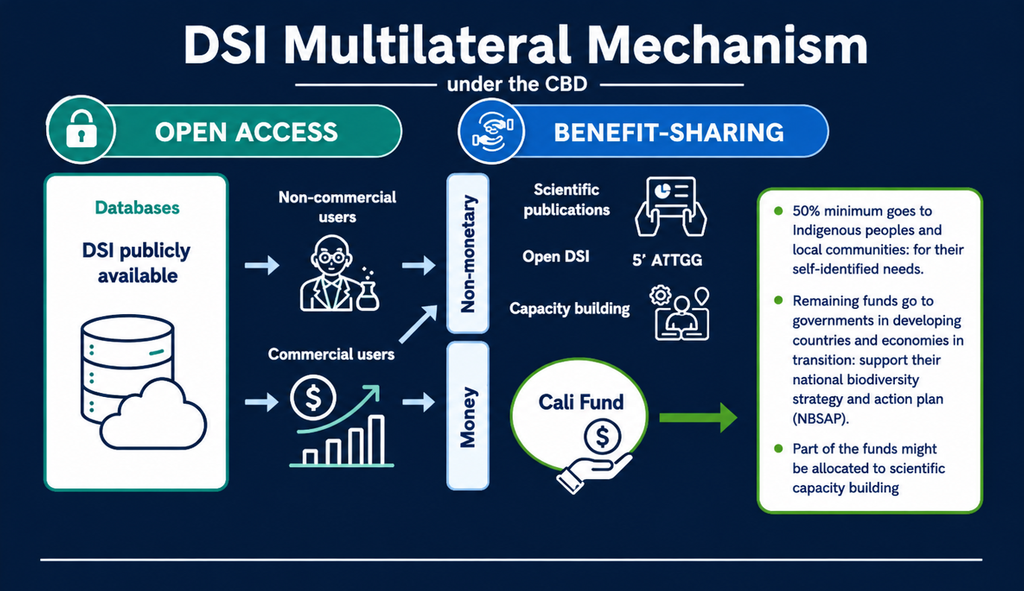
Source: Adapted from Figure 1 in Muñoz-Garcia, M.; DSI Scientific Network; and Hartman Scholz, A. (March 2025), Patterns, vol. 6, issue 3. DOI: 10.1016/j.patter.2025.101208.
What is DSI?
Digital sequence information on genetic resources, or DSI, is the digital representation of genetic material, such as DNA and RNA sequences, and potentially other linked data like amino acid sequences and molecular structures. DSI may come from plants, animals, microbes and other organisms.
Why does it matter?
DSI is widely used in research, innovation and product development across public and private sectors, including in health, agriculture, and conservation, amongst others. DSI has become foundational to commercial innovation, from pharmaceuticals and cosmetics to biotechnology and increasingly AI-driven research. The Convention on Biological Diversity Parties have decided that a Multilateral Mechanism would be the best way to close the gap between the widespread use of DSI and the fair and equitable sharing of benefits, precisely because DSI is used globally and its benefits should be shared in a way that is most effective for biodiversity, but also practical, equitable, and inclusive.
Who is involved?
The Multilateral Mechanism concerns governments, indigenous peoples and local communities, industry, researchers, civil society, and all users and beneficiaries of products and services that depend on DSI.
Guides and resources for different audiences
The Cali Fund offers guides and resources for different audiences. They provide introductory information on digital sequence information, or DSI, the Multilateral Mechanism and the Cali Fund, and direct readers to relevant official resources.
The private-sector guide introduces the Cali Fund and the Multilateral Mechanism in the context of the commercial use of DSI. It provides background information and directs readers to further information on the contribution process.
The guide for governments and policy-makers explains the policy context for the Multilateral Mechanism and the Cali Fund. It provides information on relevant CBD processes, implementation questions and available resources.
The guide for database users explains the relationship between public databases, DSI and the Multilateral Mechanism. It is intended to support understanding of developments related to the public availability and accessibility of DSI.
Explore the Cali Fund guides for the private sector, Parties and database users
COP17: A key moment for Cali Fund implementation
The seventeenth meeting of the Conference of the Parties to the Convention on Biological Diversity, COP17, will take place in Yerevan, Armenia, from 19 to 30 October 2026 under the theme “Taking Action for Nature.” The meeting will bring together Parties and a wide range of stakeholders to advance implementation of the Kunming-Montreal Global Biodiversity Framework.
At COP17, Parties will consider a consolidated draft decision on the Multilateral Mechanism, including the Cali Fund alongside the recommendation that the seventh meeting of the Subsidiary Body on Implementation SBI-7 agreed.
COP17 will have before it, as official documents:
- A note by the Secretariat on work carried out pursuant to decision 16/2, including elements of a draft decision.
- The recommendation agreed by SBI-7 earlier this year
- The report and advice of the Cali Fund Steering Committee.
- The outcomes of the AHTEG on Allocation Methodology concerning the disbursement of funds from the Cali Fund.
- An executive summary of the combined study on contribution rates and standards for identifying entities.
- The full combined study referenced above.
The Conference of the Parties will be invited to consider these documents as it progresses its negotiations under DSI.
Readers can follow official information and documentation through the COP17 meeting page.
Steering Committee advances implementation work ahead of COP17
The fourth meeting of the Steering Committee of the Multilateral Mechanism for the Fair and Equitable Sharing of Benefits from the Use of Digital Sequence Information on Genetic Resources, including the Cali Fund, was held online from 31 August to 1 September 2026. The meeting focused on the Committee’s report and advice to COP17, which covers amongst other topics, governance and operational matters, disbursement to indigenous peoples and local communities, certificates, non-monetary benefit-sharing, enabling conditions and the review of the Mechanism’s effectiveness.
The Steering Committee concluded that rule 11 of its Rules of Procedure should be considered by the Conference of the Parties for approval. It also presented three possible delivery pathways for disbursements to indigenous peoples and local communities and sought guidance on the application and further refinement of the related allocation methodology. It advised the Conference of the Parties to adopt the effectiveness-review methodology and launch the associated review process. It also advised to further consider the Secretariat’s resource requirements.
Time constraints prevented substantive consideration of the draft Operations Manual and capitalization strategy and limited discussion of certificates, non-monetary benefit-sharing and a proposed structured approach to implementation and evidence generation. The Committee agreed to hold its next meeting after COP17.
Read the Steering Committee Report
Subsidiary Body on Implementation (SBI-7) advances work on the Cali Fund
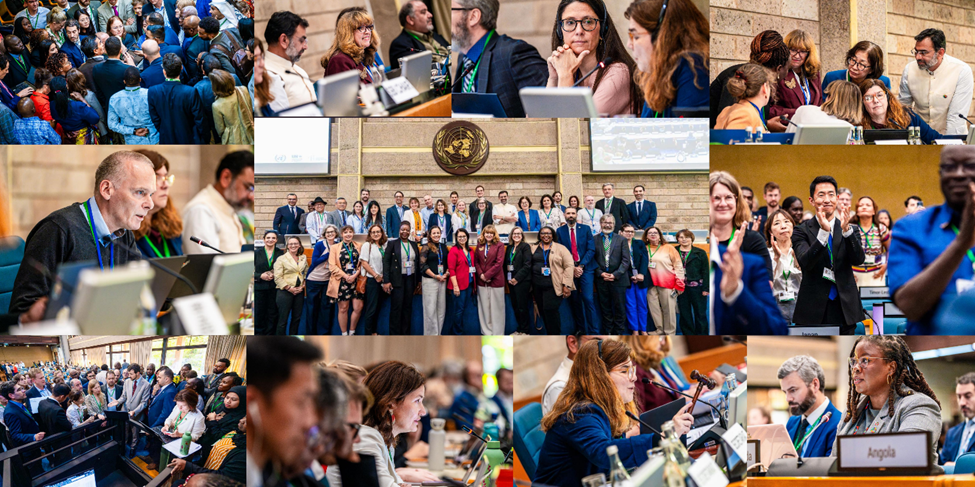
Photo credit: ENB/IISD, Photos taken during SBI-7 in Nairobi, Kenya in August 2026.
From 4 to 12 August 2026, Parties met in Nairobi, Kenya, for the seventh meeting of the Convention on Biological Diversity’s Subsidiary Body on Implementation, or SBI-7.
The meeting advanced work related to the Multilateral Mechanism and the Cali Fund. Parties considered three main items that will be taken forward in the form of a recommendation for further consideration at COP17.
- Review methodology: Parties considered the framework and methodology developed by the Steering Committee for reviewing the effectiveness of the Multilateral Mechanism and the Cali Fund. The first review of the Multilateral Mechanism and the Cali Fund is expected at COP18, in 2028
- Additional contribution modalities: Parties considered options for potential additional modalities through which contributions may be made to the Multilateral Mechanism. Discussions are expected to continue at COP17.
- Public accessibility of DSI: Parties also discussed tools and platforms that could support the public availability and accessibility of DSI in a transparent and accountable manner.
A contact group on DSI was established, co-chaired by Nneka Nicholas of Antigua and Barbuda and Ida Hellmark of Norway. Through the group’s work, Parties agreed on a recommendation on these three topics for further consideration at COP17.
The contact group also discussed the need for further information on the memorandum of understanding of the Cali Fund. In Recommendation SBI-7/4, the Subsidiary Body on Implementation requested the Executive Secretary to facilitate an online discussion on the matter, open to all, with the Multi-Partner Trust Fund Office, the United Nations partners and the Steering Committee, and to make relevant materials and documents available. It also recommended that COP17 consider a possible appropriate course of action regarding the memorandum of understanding, its annexes and related governance, administrative and operational arrangements.
The SBI-7 discussions showed continued engagement by Parties across regions on implementation of the Multilateral Mechanism. The matters advanced in Nairobi will now move forward for further consideration at COP17 in Yerevan, Armenia.
Read the official SBI-7 Recommendation on DSI
Technical Expert Group develops recommendations for an allocation methodology
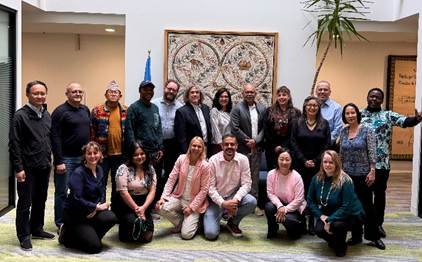
The Ad Hoc Technical Expert Group (AHTEG) on allocation methodology held its second and final meeting in Montreal from 12 to 14 May 2026, advancing technical work on the methodology for allocating resources from the Cali Fund to recipient country Parties. Established under COP decision 16/2, the AHTEG was tasked with providing technical advice and guidance on issues relating to the
disbursement of funds from the Cali Fund, including an allocation methodology.
The Expert Group followed guidance from COP16 on three indicative criteria for the allocation to be based on: biodiversity richness, geographical origin of DSI in the database, and capacity needs for conservation and the sustainable use of biodiversity.
Technical Experts from all regions, indigenous peoples and local communities from different socio-cultural regions, and relevant organizations came together at this second meeting to adopt their report, which contains three main parts: design principles for a fair, equitable, efficient, transparent and adaptable allocation methodology, the allocation methodology itself and a recommendation for future areas of work. The report introduces a criteria-based allocation methodology using the three above-mentioned criteria, with the addition of a new criterion on traditional knowledge. The report and its recommendations will be presented at COP17 in October for consideration by Parties.
Financial Contribution to the Cali Fund: E-BIOM becomes the third contributor to the Cali Fund
The Cali Fund has received its third financial contribution from E-BIOM, a Belgian-based biodiversity intelligence and environmental DNA (eDNA) company. This third contribution follows Prozomix‘s contribution in July 2026, and the first contribution from TierraViva AI Limited in 2025. E-BIOM specialises in environmental DNA, providing analyses that improve understanding of ecosystems, monitor how they change, and support environmental decision-making for businesses and public authorities. In addition to its initial contribution, the company has committed to voluntarily allocate 0.1% of the value of each of its eDNA services to the Fund annually from 2027.
These contributions establish an important precedent for companies using DSI to protect biodiversity and contribute to the self-identified needs of indigenous peoples and local communities. In line with COP decision 16/2, which encourages contributions from a broad range of DSI users, including large multinational companies, these initial contributions from smaller enterprises set the stage to scale up contributions over time. All companies benefiting from the use of DSI can play a role in advancing fair and equitable benefit-sharing and supporting global biodiversity goals.
Information on the contribution process is available from the Cali Fund team at califund@un.org.
Read the E-BIOM announcement | Background: Prozomix’s press release | Background on TierraViva AI Limited’s press release
Partner Spotlight: Friends of the Cali Fund
The Friends of the Cali Fund is a coalition of willing governments committed to supporting the implementation of the Multilateral Mechanism and the Cali Fund. Co-founded by the United Kingdom and Chile, the group brings together countries working to advance a coordinated and practical approach to operationalizing COP decisions.
At its core, the Friends of the Cali Fund reflects growing political will among Parties to move from agreement to implementation. The coalition plays an important role in the following:
- Promoting clarity and shared understanding on how the Multilateral Mechanism and the Cali Fund can function in practice.
- Building trust among Parties and supporting convergence on key implementation issues.
- Encouraging early action and sustained engagement in advance of COP17.
Effective implementation of the Cali Fund will require sustained cooperation across governments, business, indigenous peoples and local communities, civil society, academia and other stakeholders. In June 2026, the International Chamber of Commerce (ICC) welcomed the Friends of the Cali Fund’s recognition of the need to collaborate with the private sector on implementation of the Multilateral Mechanism and the Cali Fund. Through fostering continued dialogue among governments, businesses, and other stakeholders. The Friends of the Cali Fund are contributing to the shared objective of ensuring that benefit-sharing from DSI supports the conservation and sustainable use of biodiversity, contributing to the global effort to halt and reverse biodiversity loss by 2030.
The Multilateral Mechanism and Cali Fund in the news
DSI Scientific Network: Making non-monetary benefits visible
The DSI Scientific Network has published a policy brief on the generation and sharing of non-monetary benefits under the Multilateral Mechanism for DSI. The brief considers scientific collaboration, open DSI databases, data-sharing, training and capacity-building. It includes recommendations for Parties to consider ahead of COP17.
The brief reflects the DSI Scientific Network’s views and recommendations. It does not represent decisions or positions adopted by Parties to the Convention on Biological Diversity or by the Cali Fund.
Zero Carbon Analytics: Tropical forests and the future of medicine
Zero Carbon Analytics has published an analysis examining links between tropical forest conservation, future drug discovery and DSI. The analysis considers the potential value of biodiversity for pharmaceutical research and innovation. It also discusses benefit-sharing mechanisms, including the Cali Fund, in the context of biodiversity conservation and the self-identified needs of indigenous peoples and local communities.
The analysis reflects the views of Zero Carbon Analytics. It does not represent a decision or position adopted by Parties to the Convention on Biological Diversity or by the Cali Fund.
Read the Zero Carbon Analytics analysis
Media Coverage Examines Early Implementation
Recent reporting by Mongabay and POLITICO has examined the early stages of the Cali Fund’s implementation, including the need to expand corporate participation and contributions. The articles also highlight the Fund’s purpose: advancing fair and equitable benefit-sharing from the use of digital sequence information on genetic resources, while supporting biodiversity action and indigenous peoples and local communities.
As the Fund continues to build awareness and engagement, these discussions underline the importance of participation across relevant sectors and of translating the Global Biodiversity Framework’s commitments into practical action.
Read the Mongabay article | Read the POLITICO article
Ways to engage
Audience
Actions
Parties and governments
Private sector and DSI users
Learn more about the Cali Fund and consult the available resources and your respective Governments/national focal points. For information on the contribution process, contact califund@un.org.
Indigenous peoples and local communities
Follow developments related to allocation and governance; engage through relevant CBD and stakeholder processes; share perspectives through appropriate processes and representative channels.
Civil society, academia and research institutions
Support informed dialogue on DSI, open science and benefit-sharing; share relevant knowledge; follow policy developments ahead of COP17.
All readers
Subscribe to future editions; follow the Cali Fund on LinkedIn; share this newsletter with relevant networks; contact califund@un.org about contributing.